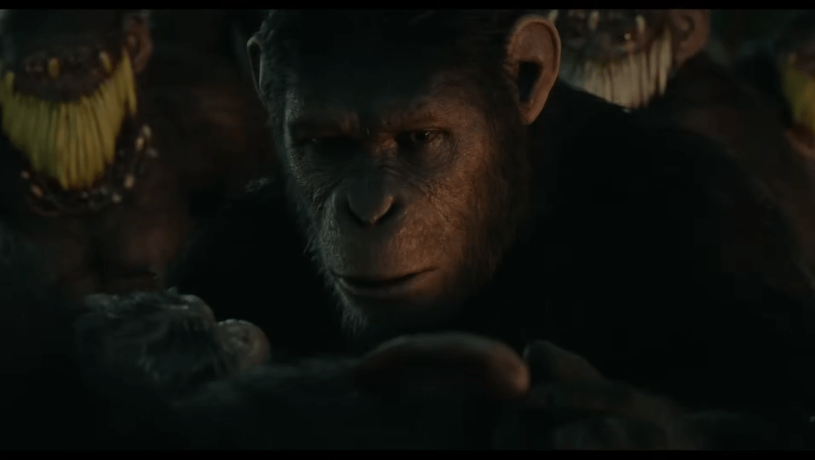
Apedolf Hitler. (Rise of the Planet spoilers)
It’s been a little too long since I started my catchup on the Planet of the Apes films, and frankly if I’d known that Dawn had an ape equivalent of the burning of the Reichstag I’d probably have watched a long time ago. Like back when the film came out. Now those of you who watched Rise of the Planet of the Apes know that the film ended on some pretty dire implications. The apes escape into the forests leaving humanity behind, but Hunsiker (David Hewlett) shows up to the airport clearly infected with a deadly virus because humans suck.
A virus that was created in a lab and spread through the world via airport? Movies sure were crazy with their premises ten years ago. Directed by Matt Reeves who would go on to direct War and also The Batman, the second movie dives deep into topics like racism, species supremacy, trust in friends, war, the consequences of one’s own actions, and how you should never trust a gun-toting ape when he asks for a swig of your whiskey.

Set ten years after Rise, Dawn of the Planet of the Apes does not star James Franco as Dr. William Rodman. They claim he died due to the virus in the intervening years, but in reality he tried to meet up with an underage ape girl at a hotel in New York City and the ape’s father beat him to death. Art imitates life I guess. In the years since the prior film, humanity has been effectively wiped out by the simian virus. Kinda racist to call it that, more on that later. Only 1 in 500 humans are genetically immune to the virus, and they’re not sure if that’s actually a true fact, and an unknown number of survivors have set up in their own enclosed civilizations.
Meanwhile the apes led by Caesar (Andy Serkis) have set up their own civilization under some pretty reasonable rules; apes are stronger together and apes don’t kill apes. Caesar has a family now with his wife Cornelia (Judy Greer) and son Blue Eyes (Nick Thurston). While Caesar hasn’t forgotten the lessons taught to him by Rodman, humanity is a distant memory. For all he knows there’s probably not even any humans left. Nobody’s seen them in years, after all.

Unfortunately the peace between humans and apes is threatened when a chance encounter leads to Carver (Kirk Acevedo) shooting and injuring one of the apes. Our main character for the human side is Malcolm played by Jason Clarke. Malcolm convinces the apes to not tear them apart and to let them try to get a power plant back up and running in order to power their town. Because if the town doesn’t have power, Dreyfus (Gary Oldman) who leads the town is going to start killing everything that moves and looks like a monkey.
Meanwhile Caesar is having problems of his own. His wife is sick, his relationship with his son is strained over political issues, and the sanctity of his home is now being threatened from forces outside and within. The lines that held ape and human apart for years are broken and while he is trying to maintain control over his leadership, there’s a faction from within led by Koba (Toby Kebbell) who just want to wipe out the remaining human population and believe that Caesar’s sympathy toward non-apes will get them all killed. A reasonable concern given the humans find out that the apes are out there and a number of them immediately turn to their own genocide plans.

Where Rise was more about the differences between humans and ape, Dawn focuses a lot on the similarities. Both sides really don’t want to go to war, but those plans keep getting screwed up by the factions within who are really hell bent on genocide. And there’s a solemn realization that this is all going to bleed out into an all out war that will cause immeasurable casualties on both sides, for two civilizations that can’t afford to lose any more people and for reasons that were completely avoidable in a perfect world.
Where the first film was an origin story for Caesar and Koba the second movie is a calm before the storm for the inevitable war in the third movie (hence the name). It’s impressive how much emotion the film can get out of CG apes, but they have compelling stories and motivations. Even Koba isn’t entirely without reason. The guy was tortured and experimented on for years in a facility, watching his fellow apes treated brutally, only to escape and watch his friends be killed again. Then years later their first encounter with humans ends in one of their own getting shot, and despite claiming friendliness, Koba discovers the humans weaponizing an armada that could only be used to wipe out the apes.

Even Caesar seems to recognize that there are plenty of good apes and humans, and just enough bad ones to ensure that peace between the two sides is probably a pipe dream.
Rating: A
 How About Notflix